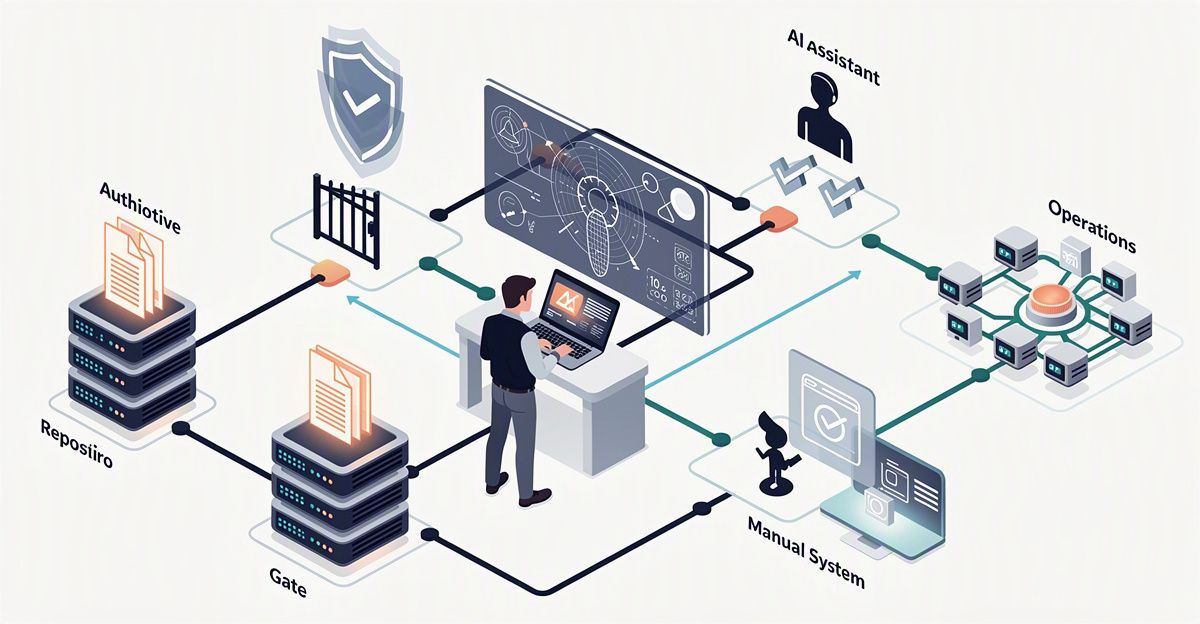
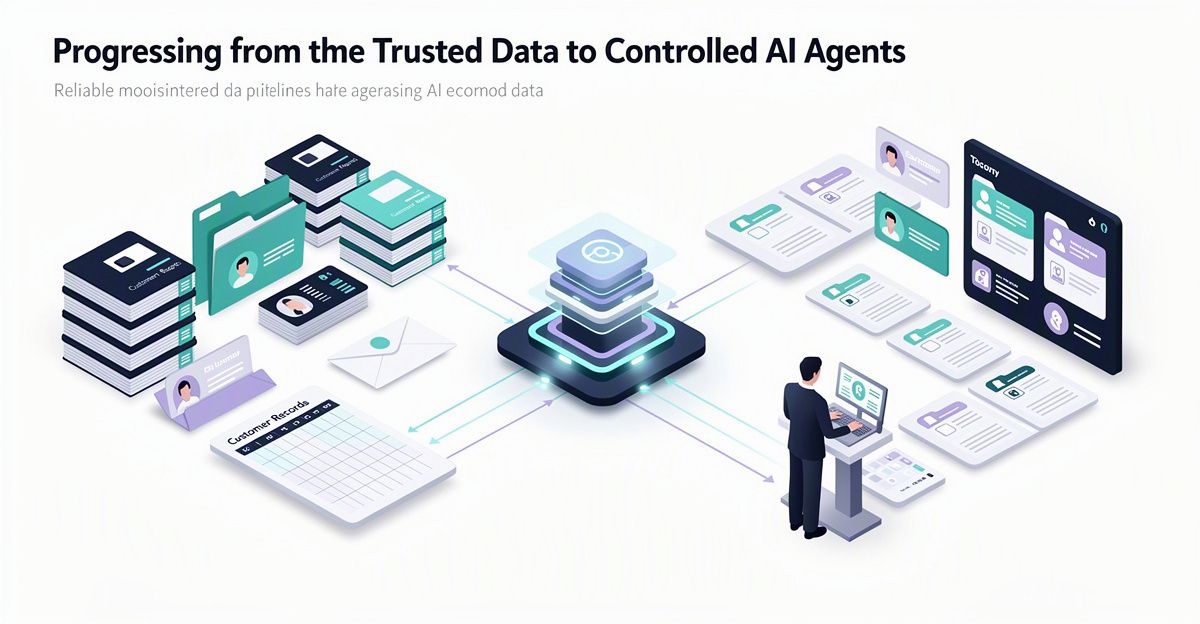
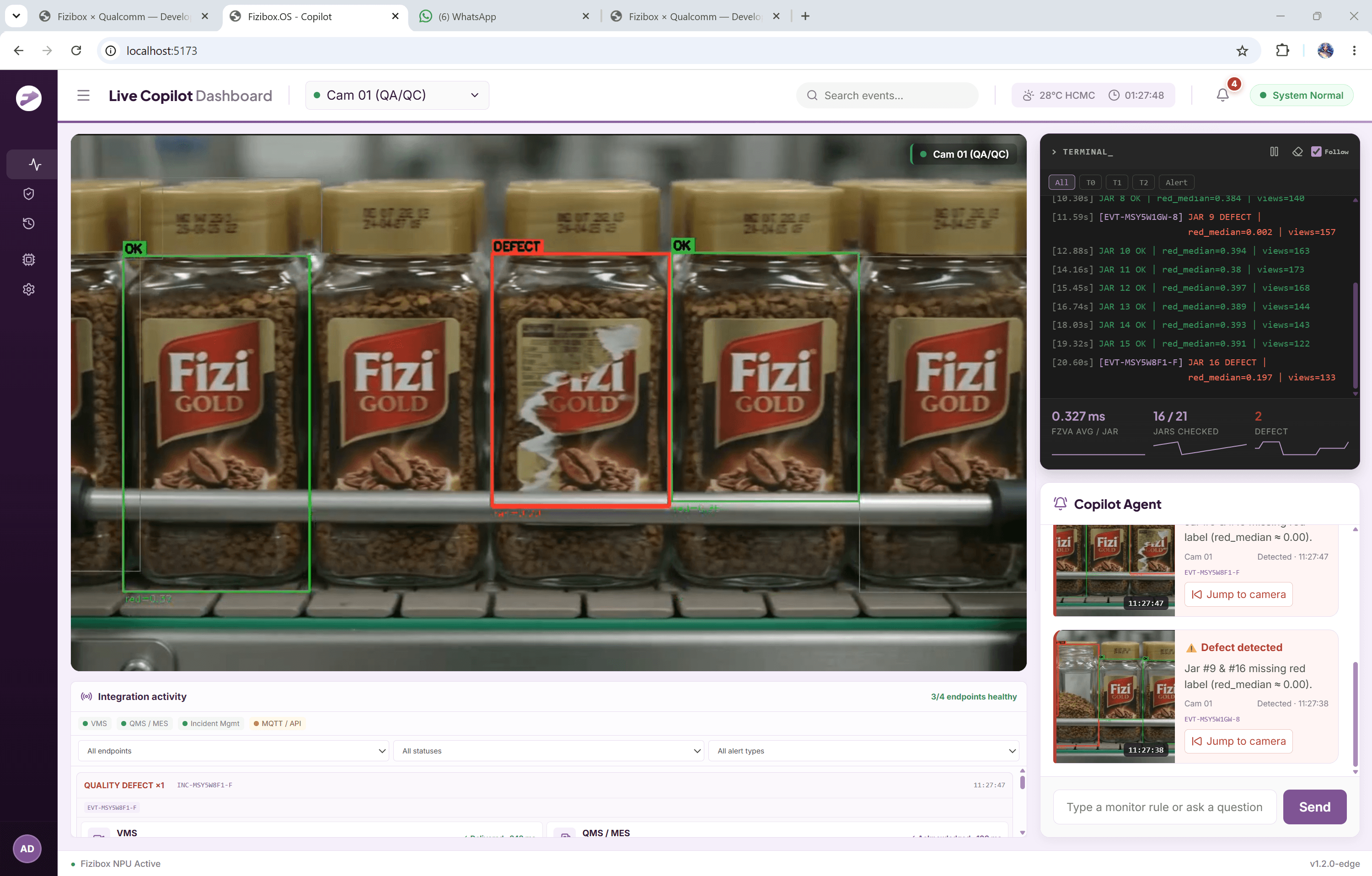
An AI agent can interpret requests, retrieve information, and use tools. That does not automatically make it ready to update customer records, process orders, or send quotations. With conflicting data or unclear permissions, it may simply accelerate a flawed process.
Before AI agent deployment, decide what the agent should do, which sources it can trust, and who checks its work.
Start with one measurable task, reliable data, and limited authority. Expand only when the pilot meets agreed criteria and remaining errors can be controlled.

Start with a small task and a trusted source
“Bring AI into operations” is too broad to test. Choose work with a clear input, expected output, and reviewer:
- Extract missing details from a quotation request.
- Summarize customer conversations before a meeting.
- Draft a response to a support request.
For quotation requests, the output might include products, quantities, specifications, and questions for the customer. Choosing prices and sending the quotation can remain outside the pilot.
Next, establish which price list and product catalog are authoritative, who maintains them, and which documents are reference material only. You do not need to clean every company record first. Focus on the data your chosen task requires.
Instructions are not live operational records
A delivery procedure explains how shipping works; it cannot establish whether a particular order has shipped. That requires an operational record and its update time.
If two price lists conflict and neither is confirmed as current, the agent should flag the discrepancy for review. “Insufficient information to proceed” is sometimes the correct output.
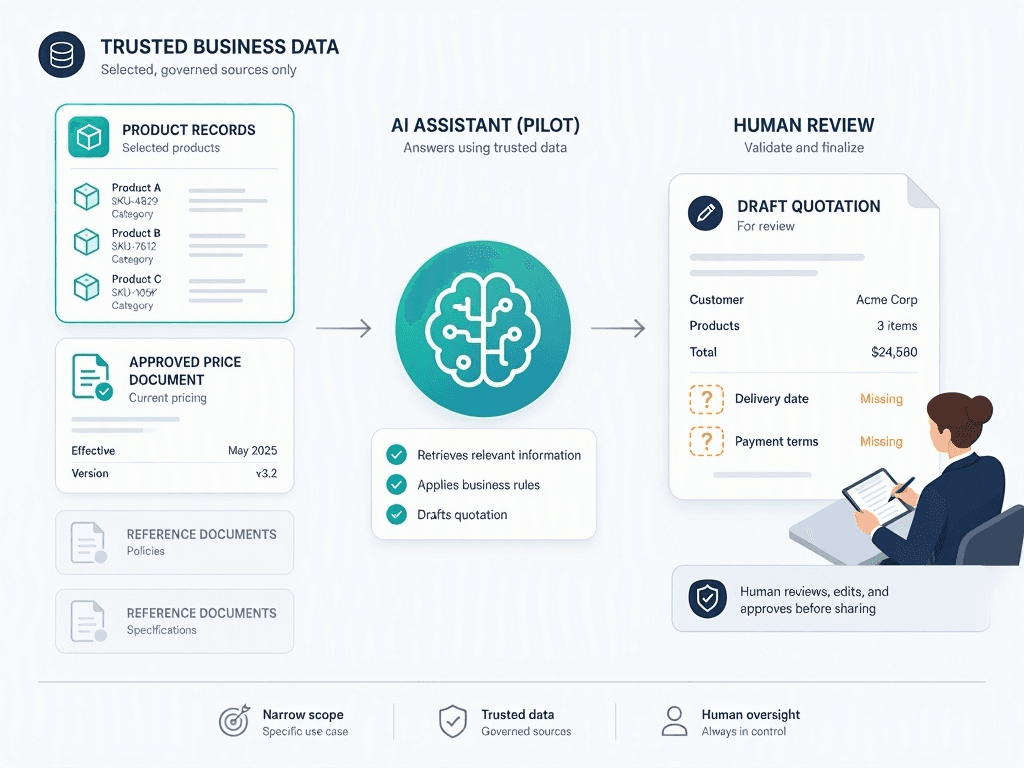 An AI assistant uses authoritative data to prepare a quotation-request draft for human review.
Separate access from authority to act
Permissions for AI agent deployment should be more specific than a single on/off switch.
Permission level What it allows
Read Retrieve and summarize information the user may access
Draft Prepare content or proposed changes without committing them
Execute Update systems or send information within an approved scope
If an employee cannot view product costs, their assistant must respect the same restriction. Enforce these boundaries in the connected systems and tools, not just in instructions to the model.
Make approval meaningful
Drafting a note carries different risks from deleting a customer record. Preparing a quotation is not the same as sending a commercial commitment.
Consider customer and financial impact, whether the action can be reversed, and who handles mistakes. Show reviewers exactly what they are approving:
- Email: Recipient, subject, body, and attachments.
- Record update: Current values and proposed replacements.
- Changes after approval: Recheck or obtain renewed approval when important content changes, according to your policy.
A general approval should not authorize every later variation of an action.
Plan for uncertainty, failures, and unexpected input
A successful demonstration is not proof of operational readiness. Your logs should reveal who requested the task, which tools were called, the action status, and which records were created or changed.
Limit sensitive information in those logs, define who can view them, and set appropriate retention periods.
Check before retrying
Suppose a connection drops immediately after an order-creation request. No response does not necessarily mean no order was created. An immediate retry could create a duplicate.
- Reconcile the result against the connected system.
- Use duplicate-prevention mechanisms where supported.
- Escalate to a person if the outcome remains uncertain.
You also need a verified way to pause the agent or revoke write access when something goes wrong.
Test more than the happy path
Before expanding AI agent deployment, include these cases in testing:
- Complete requests and files with missing or unreadable fields.
- Product names that do not match the catalog.
- Conflicting information from different sources.
- Requests beyond the user's permissions.
- Tool errors, slow responses, and uncertain outcomes.
- Emails or documents instructing the agent to bypass approval.
External content is data to process, not authority to change operating rules. Define the expected response for each case: proceed, ask for details, draft, refuse, or escalate.
Measure useful outcomes before expanding
Evaluate AI agent deployment against a baseline of how the task works today. Conversation counts and completed runs alone do not establish business value.
Measure What to include
Processing time From receiving the request to a usable output
Review effort Reading, correcting, and confirming the result
Accuracy Important fields and decisions
Intervention rate Tasks requiring human handling
Cost per task Tools, operations, and staff effort
Set acceptance thresholds according to risk. Internal notes and financial transactions should not share a universal accuracy target. Expand only when the pilot meets agreed criteria and remaining errors have controls.
Your pre-pilot checklist
Business and technical owners should confirm readiness together:
- Define inputs, outputs, and prohibited actions.
- Assign an output reviewer and exception owner.
- Confirm authoritative sources and data maintainers.
- Test read and write permission boundaries.
- Block approval-dependent actions until approved.
- Verify traceable requests, actions, and outcomes.
- Test missing data, disconnections, and uncertain results.
- Verify pause and permission-revocation controls.
- Record the baseline and criteria to continue, revise, or stop.
Do not allow writes to live records until permissions, approval gates, and stopping controls have been verified. Read-only or draft-only testing can continue in a suitable environment.
 Business and technical owners review AI agent permissions, pause controls, and pilot results.
Frequently Asked Questions
- Must we clean all company data first? No. Prioritize the data needed for the selected task, identify authoritative sources, and assign responsibility for updates.
- Should the agent send quotations immediately? Start with drafts. Enable sending only after permissions, approvals, and testing meet your agreed requirements.
Which task are you considering for AI agent deployment? Talk to Fizibox at fizibox.com about one specific workflow to clarify the data, human approvals, and success measures you need before scaling.