You may not ride a bicycle for years. Yet the moment you get back on the saddle, your hands, legs, balance, and attention begin to reconnect. It feels almost automatic. That simple human experience reveals a powerful lesson for AI training: durable learning is not just about storing information, but about building reliable patterns through practice and feedback.
For business leaders, this is more than a neuroscience curiosity. It explains why successful AI projects need clean data, real-world testing, continuous feedback, and clear performance goals. A model should not merely remember examples. It should learn how to respond well when conditions change.
The best learning is not memorization. It is the ability to act correctly in new situations, improve from mistakes, and become more reliable over time.

Your brain does not store cycling like a document
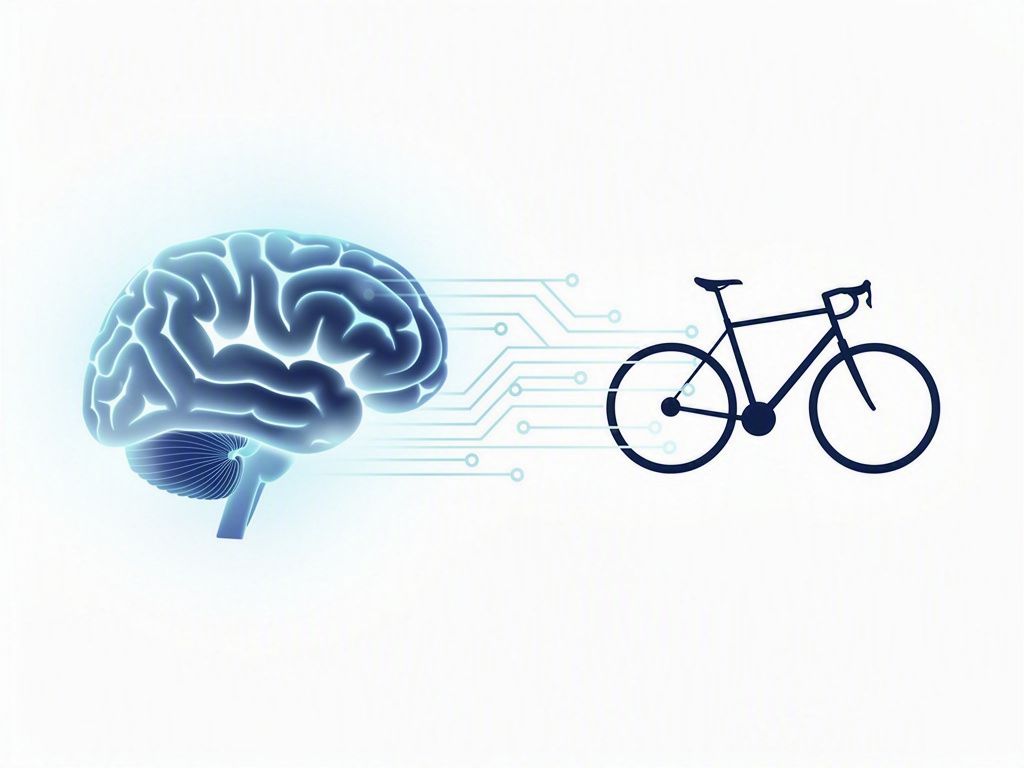 Illustration of procedural memory helping humans remember how to ride a bicycle
When you memorize a presentation, you rely on explicit memory: facts, words, sequences, and ideas you can describe. Riding a bicycle is different. It belongs to procedural memory, the kind of memory behind physical skills, habits, and coordinated actions.
That is why you may forget the details of your first cycling lesson but still remember how to keep balance. Your body does not recite instructions. It reacts, adjusts, and stabilizes.
Key traits of procedural learning include:
- Less conscious effort over time: you stop thinking about every movement.
- Learning through repetition: each attempt strengthens the pattern.
- Fast feedback: wobbling or falling immediately tells you something is wrong.
- Better transfer with practice: you can ride on different roads, not just one path.
This matters for AI because strong models are not built by memorizing isolated examples. They become useful when they learn patterns that hold up across messy, changing, real-world situations.
AI training works best when feedback is built in
AI systems do not have muscles or balance, but training a model has a familiar rhythm. The model sees examples, makes predictions, compares its output with the expected result, adjusts internal parameters, and repeats the cycle many times.
Think of data as the road, the loss function as the feeling of imbalance, and the training algorithm as the adjustment process. If the road is too simple, the model may perform well in tests but fail in real business conditions.
| Learning to ride | AI training | Business lesson |
|---|---|---|
| Repeated practice | Many training examples | Volume helps, but variety matters more |
| Wobble and adjust | Learn from prediction errors | Mistakes are useful signals |
| Ride on new roads | Test on unseen data | AI must generalize beyond the lab |
| Ride naturally | Automate a workflow | Value appears when performance is stable |
Many AI projects struggle because they are trained on ideal data but deployed into imperfect environments. Customer messages are inconsistent. Product names change. Internal documents contain outdated terms. The model needs exposure to reality, not only polished samples.
More data is not always better data
It is tempting to believe that more data automatically means better AI. In practice, messy, duplicated, biased, or poorly labeled data can make a model confidently wrong. The goal is not to collect everything. The goal is to train with information that reflects the work you actually want the AI to support.
A practical AI training plan should include:
- High-quality data: clean, relevant, and connected to business outcomes.
- Continuous feedback: from users, domain experts, and system monitoring.
- Generalization checks: tests that show whether AI performs on new cases.
- Measurable goals: such as faster response time, higher accuracy, or fewer manual steps.
A reliable AI model is like a skilled cyclist: it should not only succeed on a familiar road, but also stay balanced when the path changes.
This principle applies across use cases: customer service chatbots, document classification, demand forecasting, quality inspection, sales assistants, or internal knowledge search. Each solution needs the right training environment before it can support daily operations.
From muscle memory to dependable business AI
 Illustration of AI training learning from data, feedback, and real-world context
Once cycling becomes automatic, it frees your attention for the road ahead. AI should do something similar for your team. It should reduce repetitive work, surface useful information, and help people make better decisions without adding unnecessary complexity.
To move from a promising demo to a dependable solution, start small and train deliberately:
- Choose one clear business problem, such as reducing support ticket handling time by 30%.
- Prepare the data before training instead of fixing everything later.
- Use real examples from daily operations, not only sample datasets.
- Keep human review for sensitive or high-impact decisions.
- Monitor performance after launch because business data changes over time.
Here is a quick readiness checklist:
| Question | Why it matters |
|---|---|
| Is the data trustworthy? | Poor data leads to poor AI behavior |
| Is the goal measurable? | You need a clear way to improve results |
| Can experts provide feedback? | Domain knowledge keeps the model aligned |
| Is there an update plan? | AI performance can drift as conditions change |
This is why fizibox.com treats AI as a long-term capability, not a one-time installation. The strongest systems combine technology, workflow design, business context, and ongoing learning.
Frequently Asked Questions
- Why do we remember how to ride a bike after years? Because cycling relies on procedural memory, which stores practiced skills and coordinated actions more durably than many facts.
- What does cycling teach us about AI training? It shows that repeated practice, fast feedback, and real-world variety are essential for reliable learning.
- Can a small business benefit from AI training? Yes. Start with a focused use case such as customer support automation, document search, or sales data summarization.
Conclusion
The reason we do not forget how to ride a bike offers a simple way to understand effective AI training. Real learning comes from practice, feedback, adaptation, and performance in changing conditions. For businesses, that means AI should be trained not just to pass a test, but to work reliably in everyday operations.
If you are ready to build a chatbot, internal AI assistant, automation workflow, or enterprise software powered by real business data, visit fizibox.com and explore how Fizibox can help turn your AI idea into a practical, scalable solution.