A drone or unknown UAV near an airport is more than a security headline. For airport operators, even a short incident can delay departures, interrupt landings, pressure control teams, and create a serious safety risk.
For Fizibox, the right message is not to claim a full anti-drone system. A more practical and responsible approach is Airport Edge AI Security: an edge-based layer that helps existing cameras and sensors detect anomalies, verify events, and create trusted records for airport operation centers.
The key idea is simple: airports need faster alerts, fewer false alarms, and verifiable evidence. Edge AI can turn existing camera infrastructure into a more active layer of situational awareness.

A small alert can disrupt a large operation
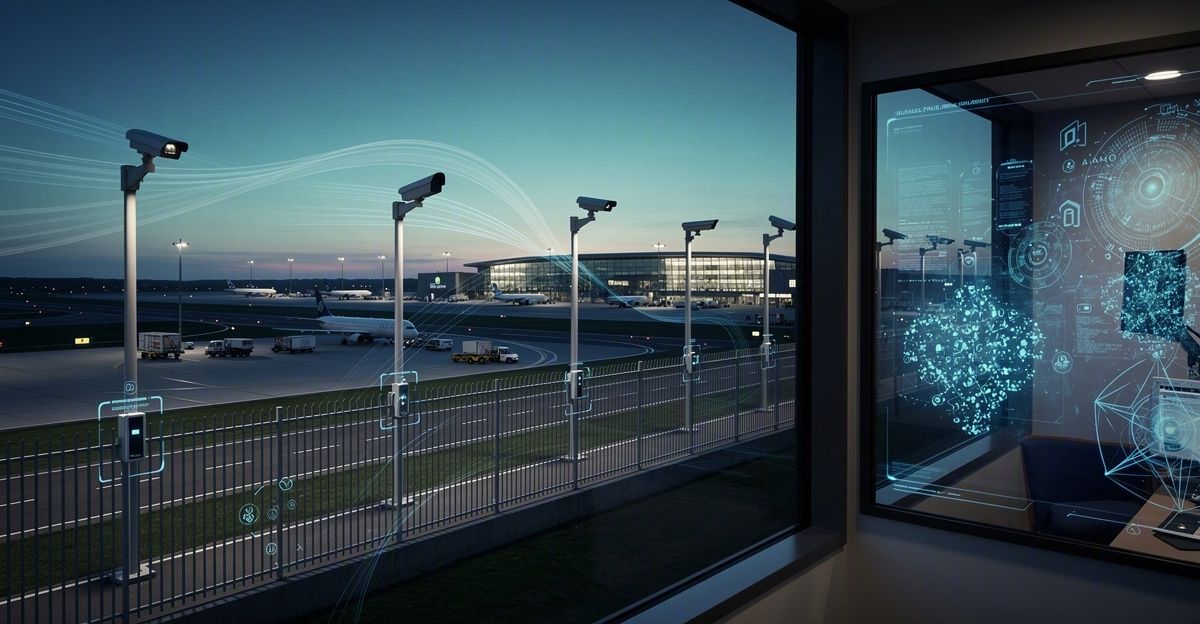
Airports are complex environments. They have wide perimeters, restricted zones, airside roads, service areas, technical facilities, and many cameras streaming at the same time. Relying only on manual camera monitoring is no longer enough for fast-moving or short-lived events.
Important anomalies may include:
- Unidentified flying objects appearing near a restricted zone.
- People climbing fences or entering areas without permission.
- Ground vehicles entering the wrong route or a prohibited zone.
- Objects left near fences, service roads, or technical buildings.
- Smoke, fire, or early signs of danger near fuel, power, or maintenance areas.
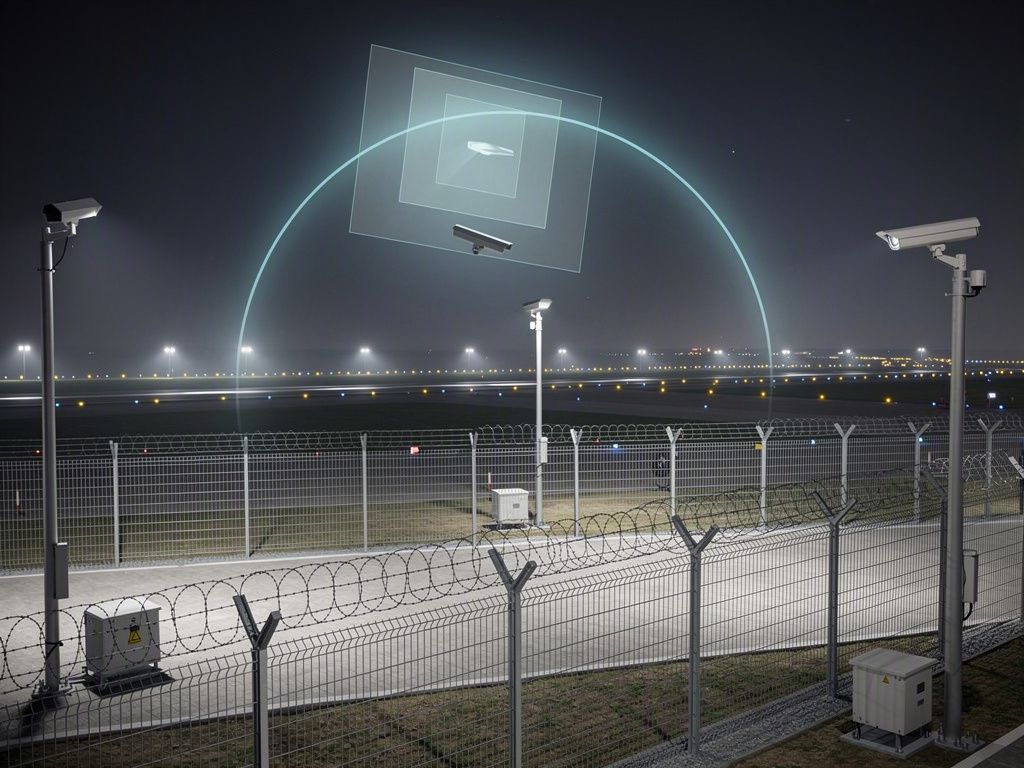 Edge AI monitoring an airport perimeter and detecting an unusual flying object
This is where Airport Edge AI Security can help. It does not replace trained airport personnel. It gives them an automated layer that watches continuously, filters noise, and escalates the right event to the right team.
| Airport challenge | How edge AI helps |
|---|---|
| Too many cameras to monitor manually | Detects predefined events automatically |
| False alarms can disrupt operations | Cross-checks visual events with other signals |
| Sending all video to the cloud is costly | Processes video locally and sends only useful metadata |
| Incidents require post-event review | Records timestamp, camera source, evidence, and status |
Fizibox fits best as a detection and verification layer
A complete counter-UAV system can include radar, RF scanners, optical and thermal cameras, acoustic sensors, tracking modules, and intervention tools. The intervention part—jamming, taking control, or disabling a UAV—is legally sensitive and requires specialized authorization.
That is why Fizibox should be positioned as an edge AI layer that supports the existing airport security system, not as a standalone drone neutralization platform. Fizibox does not need to replace radar, VMS, or the operation center. It can add intelligence closer to the data source.
In practical terms, this layer can:
- Process camera and sensor streams at the edge to reduce latency.
- Detect unusual objects, movements, or behaviors in defined zones.
- Send alerts with cropped images, metadata, camera ID, timestamp, and location.
- Fuse camera events with RF or radar signals from trusted partners.
- Create audit logs for review after an incident.
In short: Fizibox should not promise to stop every drone. It should help airports detect earlier, verify faster, and keep better technical evidence.
This positioning aligns with Fizibox.OS as an Edge AI & Trust Operating System: local processing, data protection at the source, spatial-temporal signal fusion, and trusted event records that can be reviewed later.
The best starting point is broader than drones
Drones may trigger attention, but the long-term value is broader: airport spatial security. This is where Airport Edge AI Security can deliver value step by step without forcing an airport to replace its current infrastructure.
Relevant use cases include:
- Unusual flying object detection: edge AI cameras identify small objects appearing in a prohibited zone, flying low near a fence, or moving unusually near sensitive areas. The output should be an event for verification, not an absolute claim that the object is a drone.
- Perimeter and restricted area monitoring: detecting fence crossing, unauthorized vehicles, suspicious objects, or abandoned items.
- Person-card-zone correlation: if a person appears in a restricted area without a valid identity signal, the event can be escalated.
- Camera and RF/radar event fusion: if both visual and specialized sensors detect an anomaly around the same time and location, the alert priority can increase.
- Trusted evidence at the source: every alert includes timestamp, camera source, evidence image, metadata, and handling status.
Fizibox also has relevant experience in airport environments, including a PoC at Da Nang International Airport with ACV within an appropriate scope. This should be communicated carefully: it shows that Fizibox understands airport deployment conditions, not that one product already solves every airport security challenge.
Start small and prove value with real data
For airports, starting directly on the runway or promising full-site coverage is difficult. A better path is to begin with a controlled deployment in lower-risk areas such as the perimeter, technical zones, service roads, or selected airside boundary points.
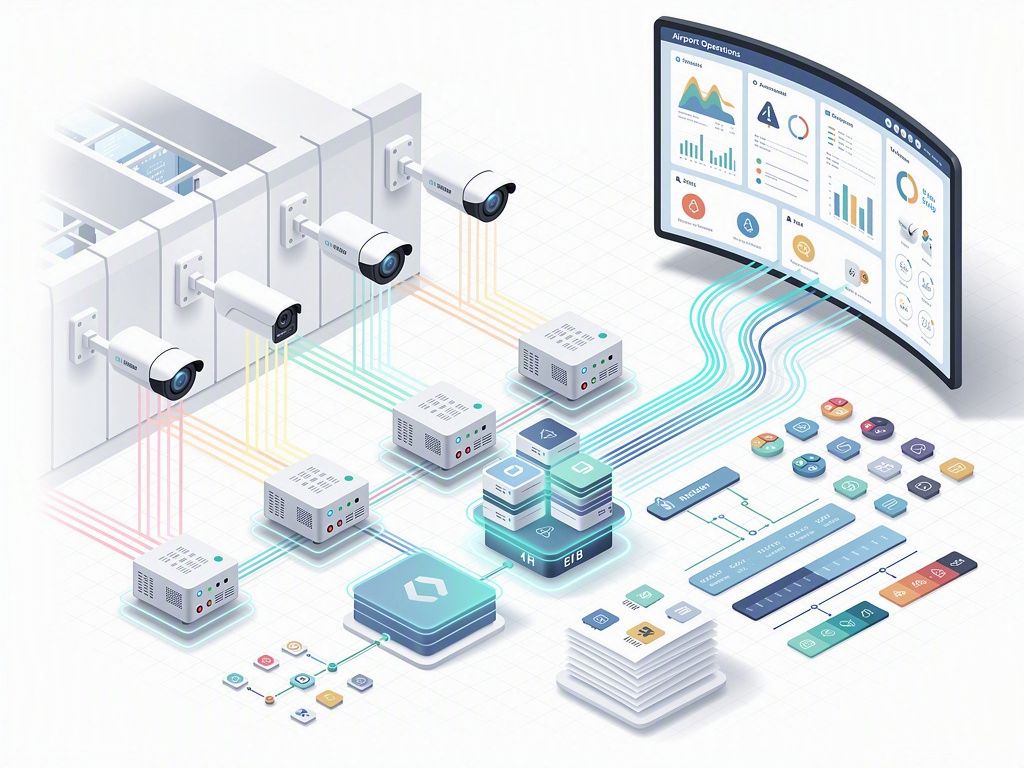 Fizibox Node deployment model for edge camera processing in airport security
A focused trial may include:
- 3–5 cameras covering selected zones.
- 1–2 Fizibox Nodes for local AI processing.
- Alert integration with an existing dashboard, API, VMS, or control system.
- A 30–60 day operating period.
- A clear report on stability, true/false alerts, and verification time.
The most useful metrics to track are:
| Metric | Why it matters |
|---|---|
| Detection time | Shows the real latency of edge processing |
| Alerts requiring human verification | Measures noise and operational load |
| True and false alerts | Helps tune models and monitored zones |
| Bandwidth saved | Proves the benefit of local processing |
| VMS and camera integration | Determines practical scalability |
Once the data is clear, the airport can gradually expand to drone-related detection with radar/RF partners, ground vehicle monitoring, abandoned object detection, smoke/fire alerts, and sensitive facility protection around data centers, fuel storage, or power stations.
This is how Airport Edge AI Security becomes a long-term operational layer rather than a one-time reaction to an incident.
Frequently Asked Questions
- Is Fizibox a counter-drone system? No. Fizibox is better positioned for detection, verification, event fusion, and trusted evidence. UAV intervention should be handled by licensed and specialized providers.
- Do airports need to replace all existing cameras? Not necessarily. A practical deployment should reuse existing cameras and sensors first, then add specialized hardware only where the data shows a clear need.
- Why process data at the edge instead of sending everything to the cloud? Edge processing reduces latency, saves bandwidth, limits raw video transfer, and keeps sensitive data closer to its source.
Airport security does not need another oversized promise. It needs a practical technology layer that can be deployed gradually, prove value with data, and help teams detect, verify, and review incidents with confidence. If you are exploring Airport Edge AI Security for perimeters, restricted zones, or existing camera systems, visit fizibox.com and talk to the Fizibox team.